




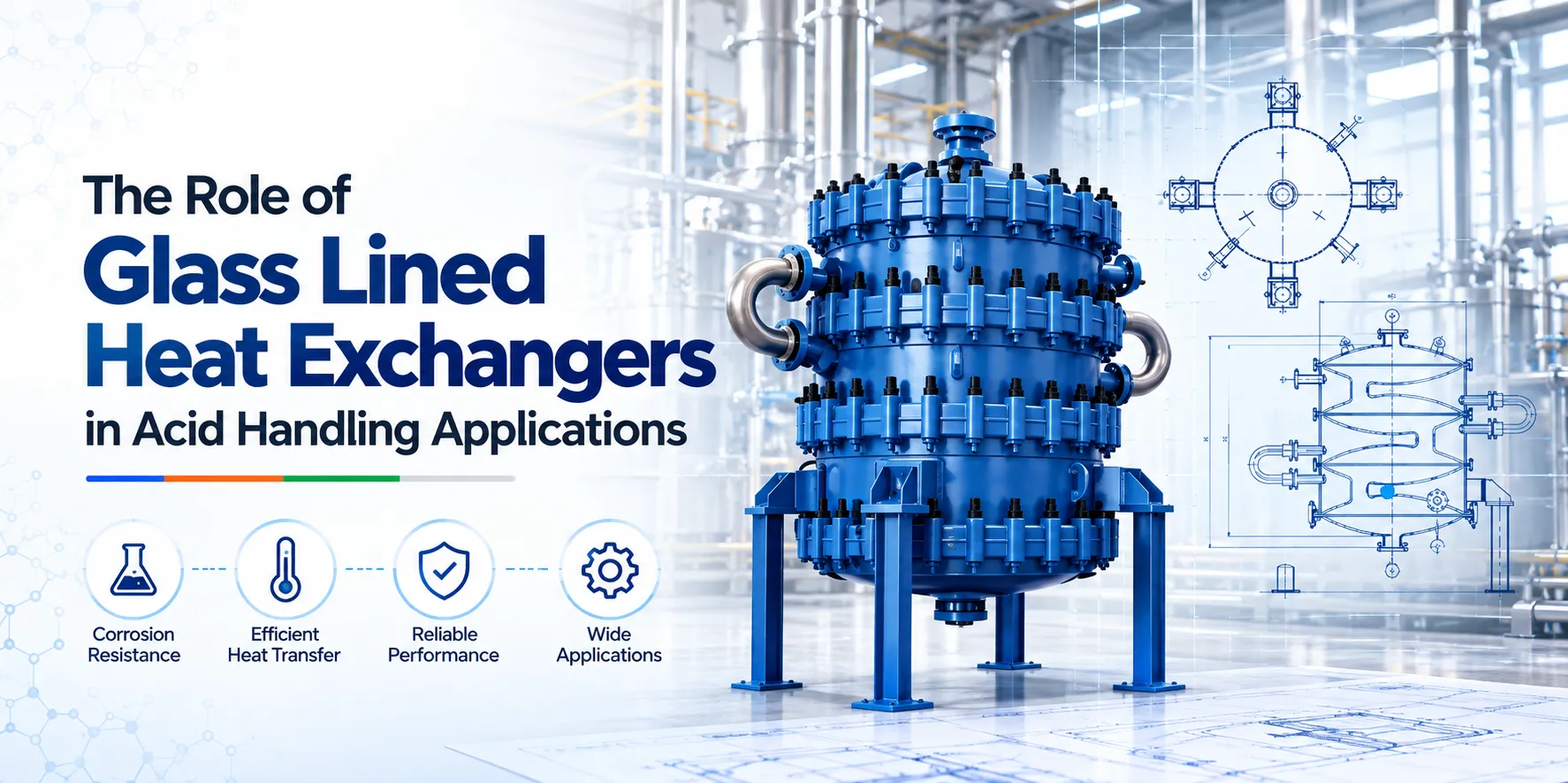
Handling acids and other corrosive process media places additional demands on heat-transfer equipment. Heating, cooling, and condensation must be managed without allowing the process material to compromise the equipment surface or introduce contamination. This is where a Glass Lined Heat Exchanger can offer a practical solution for demanding chemical processes.
Glass-lined construction combines the mechanical strength of a steel body with the chemical resistance of a glass lining, making this type of equipment relevant to chemical and pharmaceutical applications.
Why Acid Handling Needs Reliable Heat-Transfer Equipment
Acid-containing process streams can damage equipment materials. Choosing the equipment means paying close attention to chemical compatibility, how well it resists corrosion, the operating conditions it will face and how well it transfers heat.
For processes involving acids, solvents, pesticides, and other corrosive materials, the material in contact with the product is a particularly important consideration.A suitably selected heat exchanger for acid-handling applications can help provide controlled heat transfer while protecting the process environment.
How Glass Lining Supports Heat Exchanger Performance
Glass lining provides a chemically resistant surface between the process material and the underlying steel construction. Glasskem states that all product-contact parts of its heat exchangers are glass lined using GK SIGMA BLUE GLASS and GK SUPER THERMOCON GLASS, with special glasses available for specific applications.
This makes glass-lined construction relevant where resistance to corrosive media is a key equipment-selection criterion. The smooth glass surface also helps prevent product buildup and supports easier cleaning, which can be valuable in applications where product purity matters.
Key Features of Glasskem's Glass-Lined Heat Exchangers
Glasskem's equipment incorporates several design and quality-control characteristics intended for demanding process applications:
- Steel and glass-lined construction: The process side is protected by a glass lining, while the utility side is provided through the jacket around the vessel to support controlled heat transfer.
- Specialized glass lining: The specified glass lining is designed to withstand demanding chemical, thermal, and mechanical conditions.
- Controlled operating conditions: The listed operating pressure is -1 to +6 bar, while the operating temperature is specified as -25°C to 200°C. Custom designs for enhanced pressure and temperature conditions are also available.
- Quality inspections: Manufacturing includes dimensional checks according to DIN 28006 guidelines, hydrostatic testing, and spark testing of the glass lining.
- Glass lining thickness: Glasskem specifies a lining thickness of 1.0 mm to 2.2 mm.
These characteristics make the equipment suitable for demanding applications where chemical compatibility and controlled heat transfer are important.
Applications in Chemical Processing
Glass-lined heat exchangers can handle types of heat transfer needs such as heating, cooling and condensing. Glasskem finds uses in areas like chemical manufacturing, pharmaceuticals, specialty chemicals and other tough industries.
Common process contexts include:
- Chemical manufacturing
- Pharmaceutical processing
- Specialty chemical production
- Acid and solvent handling
- Processes involving corrosive materials
- Heating, cooling, and condensation duties
This makes a glass-lined unit suitable for chemical process and chemical industry applications where chemical compatibility and reliable heat transfer are required.
Benefits of Choosing the Right Glass-Lined Heat Exchanger
Selecting equipment that matches the process can provide several practical benefits:
- Chemical compatibility: Glass-lined product-contact surfaces are designed to handle aggressive process materials.
- Material compatibility: The glass lining offers a chemically resistant surface, making it suitable for challenging applications.
- Product protection: The smooth glass surface helps reduce product buildup and supports high-purity requirements.
- Process suitability: Different sizes, configurations, and customized designs can be considered according to process needs.
- Quality assurance: Inspection, hydrostatic testing, and spark testing provide important manufacturing checks.
Choosing the Right Manufacturer
The manufacturer matters just as much as the equipment specification. Engineering capability, manufacturing controls, application understanding, and the ability to provide customized designs should all be considered when selecting an industrial heat exchanger for demanding chemical service.
Glasskem provides glass-lined equipment for chemical and pharmaceutical applications and offers customized heat-exchanger designs for special requirements.
Conclusion
Acid-handling processes require heat-transfer equipment that is selected with chemical compatibility, operating conditions, and process requirements in mind. A Corrosion Resistant Heat Exchanger with suitable glass-lined construction can provide a practical approach for heating, cooling, and condensation duties involving aggressive media.
If you are evaluating equipment for acids or other corrosive chemicals, explore Glasskem's Glass Lined Heat Exchangers to understand the available solutions. For application-specific requirements or customized designs, you can also Contact Glasskem and discuss your process needs with the team.