




Distillation is the most capital-intensive unit operation in chemical processing. It is also the most vulnerable.
When process engineers specify an acid distillation column material for boiling hydrochloric acid (HCl), hydrobromic acid (HBr), or aggressive chlorinated solvents, the default choice is often exotic alloys like Hastelloy C-22, Tantalum, or Zirconium.
While effective, these materials can significantly increase the project budget.
There is a precise engineering alternative. By specifying glass lined distillation columns, you achieve strong corrosion resistance while remaining budget-conscious. This guide outlines the mechanical and process parameters for integrating a corrosion resistant distillation column into your separation loop, based on Glasskem's full range of glass lined equipment.
The Economic & Technical Case: Glass vs Exotic Alloys
The engineering logic is simple. A solid exotic alloy column requires thick walls to handle vacuum and wind load. You are paying for expensive material that provides structural strength but does not actively contribute to the separation process.
The Glass-Lined Strategy:
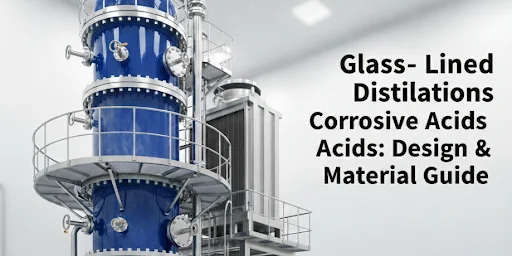
Glasskem utilizes a composite design: Carbon steel provides the structure (pressure/vacuum rating), while a high-integrity layer of glass acts as the process interface.
- Process Capability: You get the mechanical robustness of steel combined with the chemical inertness of laboratory glassware.
- Cost Efficiency: For larger diameters, the capital expenditure (CAPEX) becomes a cost-effective alternative for many acid-handling applications, without compromising lifecycle durability.
Modular Design: The Stacked Architecture
Unlike welded steel towers, glass lined distillation column design requires a modular, flanged approach.
A column cannot be glass-lined as a single continuous 20-meter unit due to furnace constraints. Therefore, Glasskem designs columns as a series of stacked, precision-flanged sections.
Engineering Criticalities:
- Vertical Alignment: Tolerances are tighter than standard vessels. Minimizing deviation is critical to prevent liquid channeling, which heavily reduces separation efficiency.
- Gasket Integrity: Each flange pair is a potential leak path. Glasskem specifies high-integrity gaskets that match the chemical resistance of the lining and the thermal expansion profile of the nozzle.
Internals: Packing Support and Distribution
A column is only as good as its mass transfer. Since welding inside a finished glass-lined shell is not feasible, the internal supports are engineered specifically around these material constraints.
1. The Support System:
Glasskem utilizes corrosion-resistant support plates that sit on a specialized main flange. These plates are engineered to handle the static load of the packing plus the dynamic liquid hold-up without point-loading the glass lining.
2. Liquid Distributors:
For high-purity separation, liquid distribution is critical. Glasskem integrates corrosion-resistant distributors clamped between the column sections to ensure uniform irrigation over the packing bed. This consistency is especially important for downstream efficiency in related components like glass lined heat exchangers.
Technical Comparison: Material Selection for Corrosive Acids
| Parameter | Glass-Lined Steel | Solid Hastelloy (C-22) | PTFE-Lined Steel |
|---|---|---|---|
| Corrosion (Hot Acids like HCl) | Excellent (Inert) | Good (Rate dependent) | Excellent |
| Vacuum Rating | Full Vacuum | Full Vacuum | Limited (Risk of liner deformation) |
| Design Temperature | Typically up to ~200°C (design-dependent) | High (>400°C) | Moderate (~180°C, creep risk) |
| Cleanability | Superior (Non-stick) | Moderate | Good |
| Contamination (Leaching) | Negligible (Chemically inert surface) | Moderate (Metal Ions) | Low |
The Purity Factor (Pharma & Fine Chem)
For pharmaceutical intermediates, corrosion isn't the only threat contamination is just as critical.
Even if an alloy resists physical corrosion, it may still shed trace metal ions into your distillate over time. In high-purity applications, this iron pickup can fail strict batch specifications.
Glass-lined surfaces are chemically inert. They offer negligible leaching, ensuring optimal product purity as emphasized in Glasskem's engineering for high-efficiency purification processes.
Engineered for Process Compliance
Whether you are recovering solvents or distilling complex acids, the mechanical design must meet local pressure vessel standards.
As a specialized glass lined reactor manufacturer, Glasskem engineers column systems that balance hydraulic capacity with mechanical integrity. We assist in configuring nozzle elevations, support plates, and interfaces for reboilers and condensers to accurately match your process simulation.
Stop over-specifying alloys. Start specifying performance.