




A reactor can finish its cycle perfectly on schedule and still leave the rest of the plant waiting. The reality on the floor is that active processing is only a fraction of the timeline. A finished batch doesn't magically appear at the next station.
It has to be safely pushed through pipelines, staged in holding vessels, and secured until the downstream equipment is actually ready to receive it. In many facilities, overall efficiency is heavily influenced by what happens during these quiet moments between major process steps.
The Reality of Out-of-Sync Production
Production stages almost never run at the exact same speed. A highly efficient reaction might take four hours, while downstream filtration or distillation takes twelve. This timing mismatch creates a natural bottleneck on the plant floor.
If a finished intermediate has nowhere safe to sit, the reactor cannot be emptied, and the next cycle is immediately delayed. Intermediate holding helps absorb these delays. . It decouples the process steps, allowing the facility to run continuously even when individual machines operate on completely different schedules.
Bridging the Process Gap with Receivers
If the transition between process stages is not planned properly, even a well-executed batch can end up waiting on the next operation. Chemical protection, however, cannot be paused during transit.
When operations evaluate Storage Tanks & Receivers , they aren't just looking for a way to move fluid. They are looking to maintain the same non-reactive environment during intermediate storage and transfer.
Storage-related problems often surface long after the original decision about containment equipment has been made because:
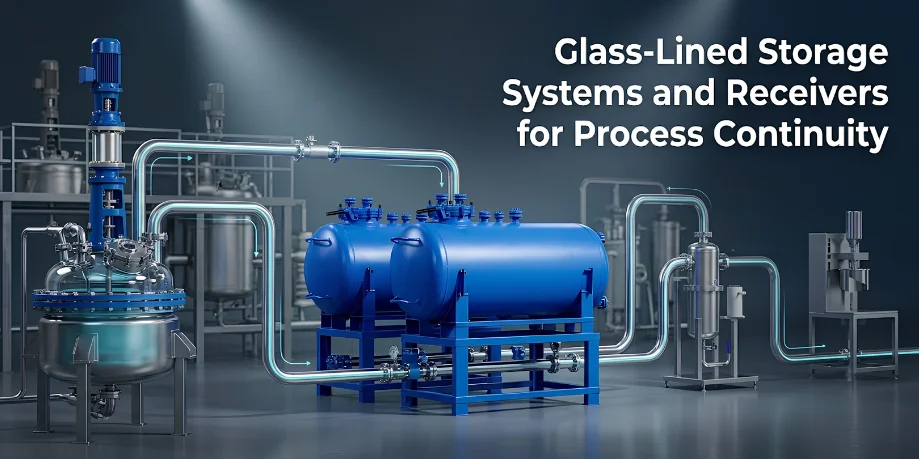
Glass-lined receivers are built specifically to manage this movement while keeping materials flowing through the process in a controlled and predictable manner. By handling the safe storage and transfer of raw materials, intermediates, and finished products,these units help prevent contamination while supporting smooth material handling.
Offered in capacities ranging from 63 L up to 20,000 L, they give plant managers the exact volume needed to stage batches securely, ensuring the material remains fully protected while waiting for its next step.
Accommodating the Changing State of the Batch
Process media rarely stays in the same physical state from the start of a campaign to the end. A facility might bring in a raw powder, transfer a thick liquid intermediate, and eventually hold a finished granule. If the transfer equipment cannot safely handle these shifts, the line inevitably stops.
The containment infrastructure has to handle that reality without skipping a beat. Industrial storage tanks and receivers are designed for this exact application versatility. The same containment infrastructure can be configured to safely store liquids, powders, or granules as the batch evolves.
When expanding operations and evaluating glass lined storage tanks Toronto, this versatility ensures that the entire process line can rely on the same containment technology, regardless of the material's current physical state.
Maintaining Unbroken Protection Across the Network
Transferring a batch safely means maintaining the same protective environment from the reactor to the final holding area. A facility might use a Glass-Lined Vertical Storage Tank for heavy-volume bulk containment while using a network of smaller receivers to actively feed the line.
If overhead space restricts the use of vertical units, operations can install a Glass-Lined Horizontal Storage Tank mounted on sturdy saddles to safely distribute the load across the floor.
No matter how the plant is laid out, the goal is to securely manage the product under demanding operating conditions. This includes maintaining safety across:
- Pressure shifts: Ranging from full vacuum up to 6 kg/cm² (g).
- Thermal demands: Handling aggressive temperature swings spanning -25°C to 200°C.
Facilities operating in demanding process environments depend on this consistency to keep processes running predictably as material moves through the plant.
Integrating the Workflow for Process Continuity
A material may only spend a few hours moving between process stages, but that brief window dictates the efficiency of the entire campaign.
For facilities expanding operations across Ontario and other industrial regions, integrating specialized transfer units ensures that the material never drops out of a protected environment during transit. Maintaining continuous, safe movement through chemical storage tanks and dedicated pharmaceutical receivers prevents unexpected delays from derailing the production schedule.
True workflow reliability requires more than just high-performance reactors. It requires the ability to move, stage, and hold materials seamlessly between those reactions. When transfer operations match the quality of the active processing equipment, the facility stops waiting on materials and starts operating with genuine predictability.
The most effective storage networks are rarely evaluated in isolation; they are built to support the rhythm of the plant.
If you are reviewing your material handling setup or upgrading a transfer line, exploring reliable corrosion-resistant storage vessels provides a clear path to smoother operations.
Contact Us to discuss the dimensions, capacities, and custom configurations required to securely connect your process stages.
FAQ’S
Glass-lined receivers help safely store and transfer raw materials, intermediates, and finished products while maintaining a non-reactive environment throughout the process.
Glass-lined storage tanks and receivers are available in capacities ranging from 63 L to 20,000 L, allowing facilities to accommodate different process requirements.
Yes. Glass-lined storage systems can be configured to handle liquids, powders, and granules, making them suitable for a wide range of industrial applications.
Both provide the same protective glass-lined barrier. The choice between vertical and horizontal configurations usually depends on available space and the overall plant layout.