




A batch may spend only a few days inside a reactor but several weeks in storage. Yet storage rarely receives the same level of attention as active processing equipment. Once production ends, the focus naturally shifts to the next operation.
The material, however, remains exposed to the same chemical realities that existed during processing. For corrosive chemicals and high-purity products, the holding phase often becomes one of the most important stages in protecting both product integrity and equipment reliability.
Managing Chemical Activity During the Holding Phase
It is incredibly easy to treat a bulk container as a passive box. Once a batch finishes active processing, operations naturally assume it is safe. But holding raw materials, intermediates, or finished products remains a highly active chemical environment.
The fluid is simply waiting between stages, meaning its chemical properties continue to test the limits of its container. If the containment conditions slip, the expensive work executed during the reaction phase is entirely lost. A resting batch is never truly resting.
Identifying Silent Failures in Long-Term Storage
Process equipment receives constant, daily scrutiny. A holding vessel is frequently left alone. Serious operational issues tend to develop quietly because of this exact blind spot.
Equipment degradation from chemical attack is rarely a sudden event. A tank can look perfectly healthy from the walkway while the product inside is gradually being compromised.
Storage-related problems often surface long after the original decision about containment equipment has been made because:
- Extended exposure times: Holding periods frequently outlast the processing stage itself, giving subtle chemical interactions weeks to ruin a batch.
- Delayed discovery: Operators often discover the consequences only when the material returns to the process line.
By the time the issue is caught by quality control, the damage is already done.
Safeguarding High-Purity Batches Over Extended Timelines
For facilities managing biotechnology, food processing, or pharmaceutical manufacturing, uncompromised product integrity is the baseline requirement. These highly sensitive products often require extended holding periods between active stages.
If the containment surface reacts with the fluid, the product's original quality, consistency, and safety are immediately compromised.
The challenge is that contamination rarely announces itself immediately. In many cases, the material appears unchanged until it reaches the next stage of production. The objective remains the same: protecting product integrity throughout the entire holding period by securing a completely non-reactive barrier.
Evaluating Containment Quality vs. Storage Capacity
When a plant expands, procurement teams naturally focus on capacity. The instinct is to secure a container large enough to handle the increased output. But volume is only a fraction of the storage equation.
Duration and material compatibility dictate long-term success far more than sheer size. Extended holding periods place very different demands on a vessel than short-term storage. Longer holding periods expose subtle weaknesses in containment quality that shorter processing stages simply never reveal.
When teams evaluate Storage Tanks & Receivers , prioritizing the quality of the containment surface over raw capacity is what ultimately prevents these slow-developing failures. A larger tank that reacts with the media doesn't just create a maintenance headache; it creates a much larger volume of ruined product.
The Limits of Standard Steel in Aggressive Environments
Standard materials consistently fail against extreme process demands. Aggressive substances actively attack unprotected walls across the entire pH spectrum.
Industrial chemicals like bromine, heavy acids, and caustic materials heavily punish standard chemical storage tanks. These failures are rarely dramatic. They usually take the form of slow, relentless wear that eats quietly into maintenance budgets.
When a surface cannot resist this constant exposure, it leads to:
- Premature equipment replacement
- Unexpected maintenance turnarounds
- The introduction of unwanted contaminants directly into the batch
Engineering a Completely Non-Reactive Storage Barrier
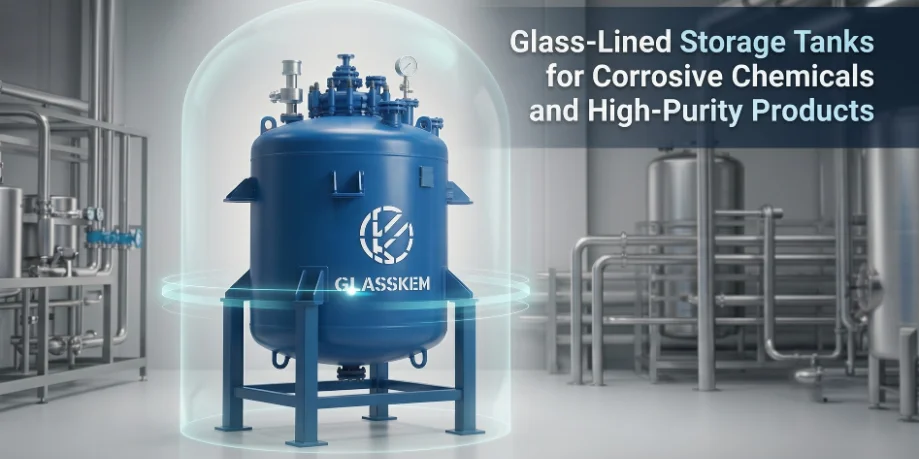
The goal is simple: prevent the stored material from interacting with the containment surface. Glass lining achieves this by creating a stable barrier between the product and the underlying steel structure.
This specific combination gives facilities a vessel that pairs heavy mechanical strength with total chemical resistance. These corrosion resistant storage vessels are engineered to manage demanding conditions, safely operating under:
- Pressures: Ranging from full vacuum up to 6 kg/cm² (g).
- Temperatures: Spanning -25°C to 200°C.
Facilities operating in demanding process environments often prioritize containment systems capable of maintaining product protection under challenging operating conditions.
Depending on facility requirements and available floor space, storage systems can be configured as a Glass-Lined Vertical Storage Tank while maintaining the exact same protective barrier.
When overhead clearance restricts the use of a vertical setup, utilizing a Glass-Lined Horizontal Storage Tank ensures the material remains protected regardless of the plant's physical geometry.
The lifecycle of an industrial batch doesn't care if the material is actively reacting or simply waiting. The chemical demands on the containment system persist long after the agitator stops turning.
Storage systems influence product quality, equipment life, and operational reliability for weeks or months after active processing ends.
Treating the holding phase as an afterthought often leads to invisible equipment degradation and expensive batch failures down the line. When the storage infrastructure matches the quality of the process equipment, the entire plant operates with predictability.
Capacity determines how much material a tank can hold. The quality of the containment environment determines whether that material reaches its destination unchanged.
If you are reviewing your containment infrastructure or evaluating long-term storage requirements, exploring reliable storage solutions provides a clear path to safer and more predictable operations for facilities across Canada and North America.
Contact Us to discuss the dimensions, capacities, and custom configurations required for your specific process layout.
FAQ’S
Glass-lined storage tanks provide a non-reactive barrier that helps resist chemical attack and protect both the equipment and the stored product. This makes them suitable for handling aggressive chemicals and high-purity materials.
The glass lining helps prevent direct interaction between the stored material and the steel shell. This reduces the risk of contamination and helps preserve product quality during extended storage periods.
Standard glass-lined storage tanks are designed to operate from full vacuum up to 6 kg/cm² (g) and handle temperatures ranging from -25°C to 200°C, depending on the application requirements.
Vertical and horizontal storage tanks provide the same corrosion-resistant barrier. The choice between them usually depends on available floor space, plant layout, and installation requirements.