




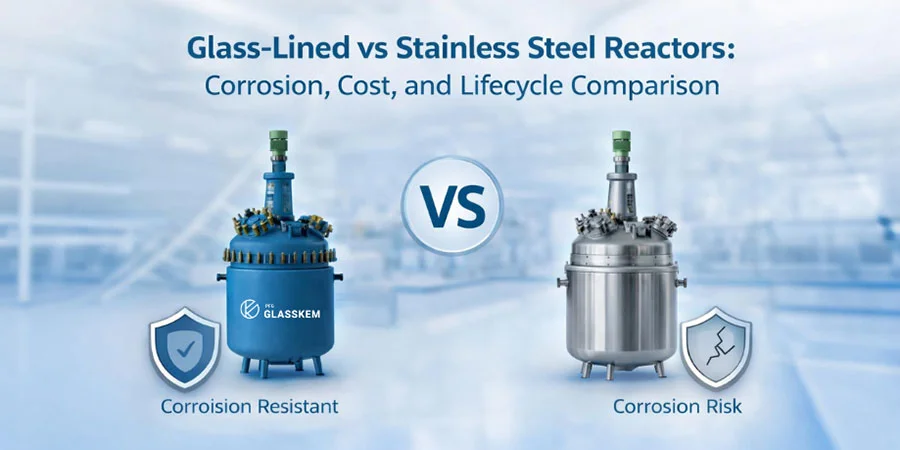
Stainless Steel (SS 316L) is a reliable industrial workhorse, but stainless doesn't mean invincible.
We see this oversight on P&IDs frequently. A process engineer specifies SS 316L for a reaction involving hot hydrochloric acid, assuming the Stainless label guarantees safety. It works on paper. It rarely survives startup.
Six months later, maintenance is scheduling a shutdown because chloride stress corrosion cracking (SCC) has compromised the weld zone.
If you are dealing with aggressive acids, relying on a passive oxide layer is a gamble. This guide breaks down the technical trade-offs between glass lined reactors and solid stainless steel, helping you balance corrosion resistance with GMP compliance.
The Corrosion Reality: Pitting vs. Inertness
Stainless Steel (316L) relies on a microscopic chromium oxide layer. If you scratch it during agitation, or if the chemical environment is reducing, that layer dissolves. Once chlorides penetrate, pitting becomes localized and rapid.
Glass-Lining doesn't have a passive layer. It is the layer.
Glasskem's lining is chemically inert to most mineral acids and organic solvents. With rare exceptions like HF, it doesn't resist corrosion, it ignores it.
As a dedicated glass lined reactor manufacturer, we design the AE Type Reactor as the standard solution for these aggressive media.
- Pressure: Typically rated for full vacuum to moderate pressures .
- Thermal: Designed for operational windows from -25°C to 200°C (subject to thermal shock limits).
Technical Comparison :
| Parameter | Glass-Lined Reactor | Stainless Steel Reactor (316L) |
|---|---|---|
| Corrosion Resistance | Excellent | Limited (Chloride Risk) |
| Thermal Shock | Sensitive | Excellent (Fully ductile) |
| Pressure Capability | Moderate | High (Customizable) |
| Contamination Risk | Very Low | Moderate (Metal Leaching) |
The Hybrid Solution: SS External / Glass Internal
Sometimes you need stainless steel but only on the outside.
In FDA-regulated facilities, painted Mild Steel chips and rusts. That is a contamination risk for the cleanroom.
The Solution: The SS AE glass-lined reactor.
- Internal: Glass-lined for chemical resistance.
- External: Polished Stainless Steel (SS 304) shell.
You can wash down the exterior with caustic cleaners, while the interior handles the aggressive chemistry that would destroy a standard stainless shell.
Lifecycle Cost: The Exotic Alloy Trap
When 316L fails, engineers often panic and specify exotic alloys like Hastelloy (C-22).
The Cost Reality:
- Solid Hastelloy: High CAPEX + Long Lead Time.
- Glass-Lined Steel: Moderate CAPEX + Standard Availability.
Experienced glass lined vessels manufacturers know that for many acid-handling applications, glass-lined steel can effectively replace exotic alloys at a fraction of the price. You aren't paying for a solid wall of expensive metal just the lining that does the work.
However, operational discipline is required. Gasket creep and agitator torque must be managed to protect the lining integrity over decades of service.
Decision Matrix: When to Choose What
- FOR High-Acidity Environments (HCl, HBr): Choose Glass-Lined Steel. While stainless alloys rely on a vulnerable passive layer, glass is chemically inert. It doesn't just resist aggressive mineral acids; it is unaffected by them.
- FOR High-Pressure or Mechanical Impact: Choose Solid Stainless Steel. In processes involving abrasive slurries, high-velocity agitation, or potential mechanical shock, the ductility and structural toughness of 316L are required to prevent catastrophic lining failure.
- FOR GMP/Cleanroom Compliance + Corrosive Chemistry: Choose the SS AE Hybrid Series. This system provides the best of both worlds: a polished SS 304 exterior shell that meets stringent FDA washdown standards and a glass-lined interior to handle the aggressive chemistry.
System View
We often see a robust reactor paired with a standard stainless heat exchanger. The reactor survives, but the exchanger fails prematurely.
If the chemistry requires a glass-lined vessel, it typically requires glass lined heat exchangers and a proper glass lined storage tank downstream.
- Integrity: Spark testing is conducted using high-voltage protocols (manufacturing and post-hydro) to detect pinholes.
- Efficiency: Plate designs pack significant heat transfer area into a compact footprint.
As a primary source for Glass-lined equipment Canada relies on, we ensure the entire loop is chemically compatible.
Don't Guess. Verify.
Material compatibility tables are just guides. Your process has unique variables.
Stop guessing . Send us your chemical composition and process parameters. We can simulate the conditions in our facility to confirm if our systems are the right fit for your plant.